A rainy fifth of November is always a gift for me. Whether it’s the spring rain of New South Wales today, or a rainy day of an autumn in Europe.
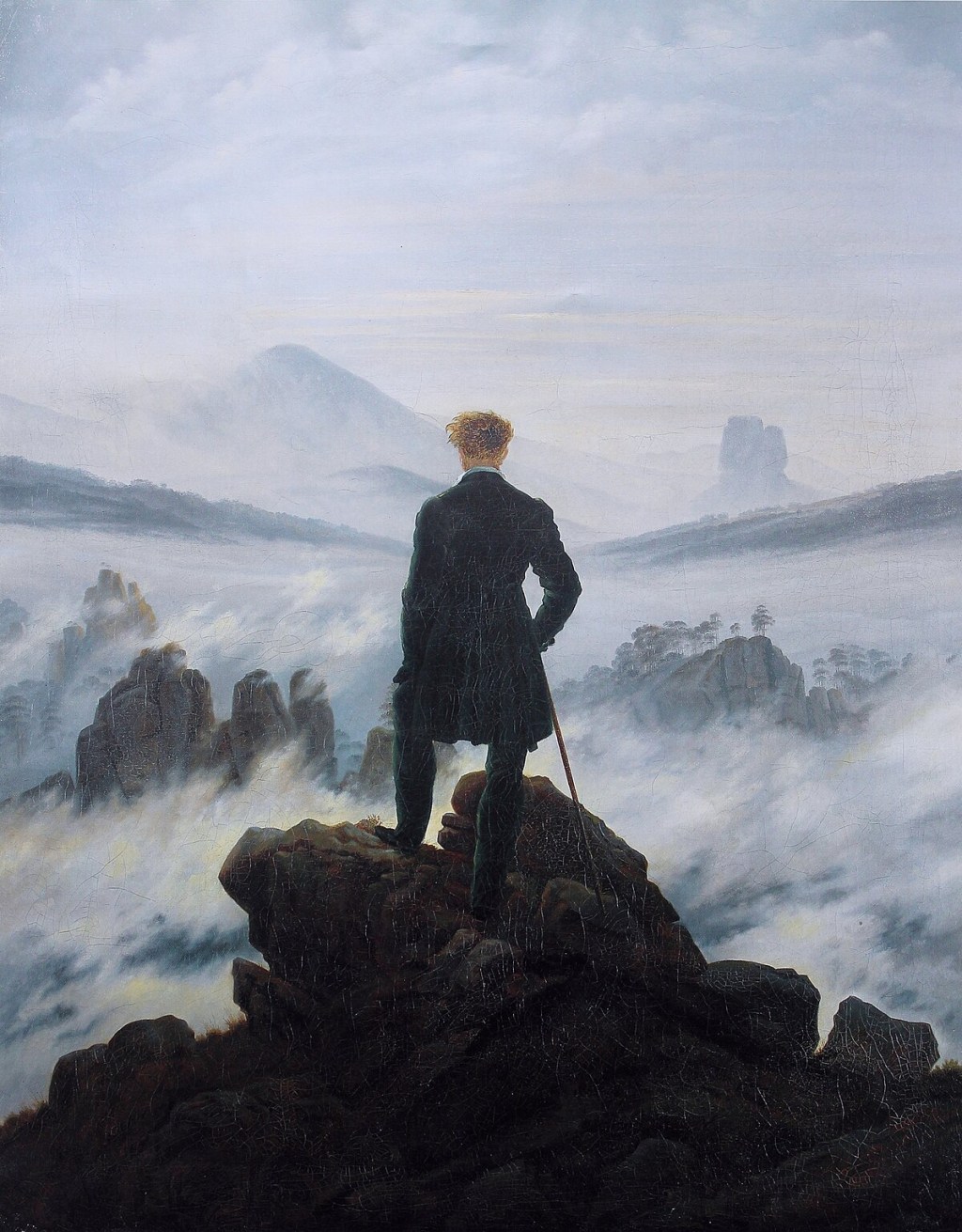
Caspar David Friedrich painted “Wanderer above the Sea of Fog” in 1818, then aged in his forties, he celebrated his marriage to Caroline Brommer at the beginning of the year. He lives in Dresden, halfway between Berlin and Prague, but he likes to find inspiration in the nature he visits during his trips to the Baltic Sea or Saxon Switzerland. Solitary, he defends himself sensitively: “You call me a misanthrope, because I avoid the company of men. You are wrong, I love the world, but in order not to hate people, I refrain from associating with them. » This sentimentalism, the German artist found how to transcend it in his painting, a cutting painting for its time, because it is full of ideals on the representation of landscapes and the treatment of religion.
My personal attachment to this painting and this artist dates back to 2013. A year during which I left the army and embarked on my first solo trip abroad. In Italy for 3 months, I finished reading “The Magic Mountain” by Thomas Mann on July 4 on the summit of Monte Tauro, above Taormina in Sicily. A very memorable day in my life. On the cover of the book, a work by Friedrich. When I returned to France, my desire to learn German has never been stronger.
This traveler on a sea of clouds faces the landscape, but not only that. The painter paints himself in the landscape, he is the landscape, and we follow him in this Oneness. This is why this painting touches me intimately. The Oneness represented is the one that I discovered 10 years ago within myself.
I hope that this article has made you want to visit the Kunsthalle museum in Hamburg where the painting is now located. There is no doubt that in the future, for my first trip to Germany, I will come and see this masterpiece with my own eyes.
———
Un 5 novembre pluvieux est toujours un cadeau pour moi. Que ce soit la pluie printanière du New South Wales aujourd’hui, ou celle des automnes d’Europe.
L’artiste et l’œuvre dont je souhaite parler ici ne font qu’un.
Caspar David Friedrich a peint « Le Voyageur contemplant une mer de nuages » en 1818, alors âgé de la quarantaine, il célèbre en début d’année son mariage avec Caroline Brommer. Il vit à Dresde, à mi chemin entre Berlin et Prague, mais il aime à trouver l’inspiration dans la nature qu’il visite lors de ses voyages vers la mer Baltique ou en Suisse saxonne. Solitaire, il s’en défend avec sensibilité: « Vous me dites misanthrope, car j’évite la compagnie des hommes. Vous faites erreur, j’aime le monde, mais pour ne pas haïr les gens, je m’abstiens de les fréquenter. » Ce sentimentalisme, l’artiste allemand a trouvé comment le transcender dans sa peinture, une peinture tranchante pour son époque, car pleine d’idéaux sur la représentation des paysages et le traitement du religieux.
Mon attachement personnel pour ce tableau et cet artiste remonte à l’année 2013. Une année durant laquelle je quitte l’armée et m’engage dans mon premier voyage à l’étranger en solitaire. En Italie depuis 3 mois, je termine alors la lecture de « La Montagne Magique » de Thomas Mann le 4 juillet sur la cime du Monte Tauro, au dessus de Taormine en Sicile. Une journée très marquante dans ma vie. En couverture du livre, une œuvre de Friedrich. A mon retour en France, mon désir d’apprendre l’allemand n’a jamais été aussi fort.
Ce voyageur sur une mer de nuages fait face au paysage, mais pas seulement. Le peintre se peint dans le paysage, il est le paysage, et nous le suivons dans cet union. C’est en cela que ce tableau me touche intimement. L’union représentée, est celle que j’ai découverte il y a 10 ans au bout de moi-même.
J’espère que cet article vous aura donné l’envie de visiter le musée Kunsthalle d’Hambourg où l’œuvre se trouve. Nulle doute que dans l’avenir, pour mon premier voyage en Allemagne, je passerai voir ce chef d’œuvre de mes propres yeux.
 The HeArt of Now-Here
Leave a comment