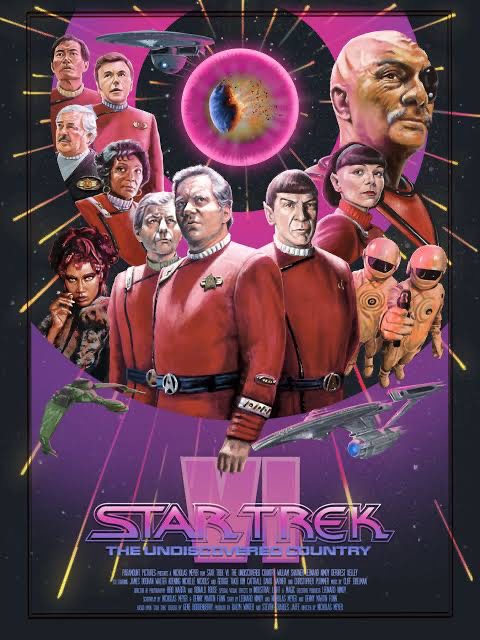
“Live Long and Prosper”, a few words that still resonate in the immensity of the galactic night. Long after the death of his original interpreter, Leonard Nimoy, the fictional character from the planet Vulcan known as “Spock” continues his adventures on the screens. He first appeared on television in 1966, 11 years before the release of the very first Star Wars film.
Star Trek “The Undiscovered Country” is the final cinematic appearance of the entire original crew. Directed by Nicholas Meyer, famous for his direction of the second film in the franchise (“Revenge of Khan” which became cult for many “Trekkies”). We are in 1991 when this film is released, and it closes the epic of the ship “Enterprise” under the command of Captain Kirk. A certain number of things have changed since the end of the sixties. The Cold War has frozen and morals have undergone significant changes within American society. The universe created by Gene Roddenberry continues to expand to the delight of the fans of all generations across all galaxies.
“The Undiscovered Country” is my favorite Star Trek movie so far, why? First for the production which honors the casting, but also for the story co-written by Leonard Nimoy. A final journey as an apology for tolerance and forgiveness, which fits perfectly with the creator’s lifelong desire to make it an entertainment with an ethical scope. Of course we find our “Klingons” friends there, with a beautiful interpretation of Christopher Plummer as a Shakespearean war leader. And then the Vulcans, with Kim Catrall as Spock’s protégé. Finally, the presence of the entire original crew, for a final touch to celebrate all these beautiful people and what they have accomplished over 4 decades. A special film for any lover of Roddenberry’s work.
Star Trek, fantasy projection of a possible future. A work that can be described as the modernist counterpart of The Lord of the Rings, this book rooted in the old Europe written by Tolkien, in which animist myths and pagan polytheism have been transmuted. In America, land of the “new world”, this futuristic dream of our moralizing Western societies was created 10 years later, metaphorically staging the transmutation of the colonial past, under a federal and trans-species intergalactic ideal. Cathartic, in the midst of decolonization. But not only that, these two universes also transcend the limits of reality as it is still defined today. Their common success is this “fantasy”, so sweet for our imagination, which only asks to escape from this everyday reality sometimes (unfairly) poorly appreciated. It transports us elsewhere and offers us another repository of experience, with its own rules and customs. Heroism has its part too of course, and participates in this re-enchantment of the world in fiction. A cult of entertainment then? In part, but not only, because that would amount to omitting the entire beneficial arsenal of ideas and values transposed and transmitted in these stories. Yes, many people take refuge there and will take refuge there again tomorrow, sometimes finding a feeling of control and understanding over the “near” environment, just as others will turn to video games, professional sport or conspiracyism. So many consumer products and controlled counter-powers of the capitalist spectacle society. But these wanderings in Middle-earth or across the galaxies also offer and will offer for a long time an invitation to adventure, to going beyond one’s known horizon (and therefore also one’s intellectual and cultural horizon), or even to the celebration of life in all its forms, both so close and totally “foreign” to ours.
I could talk more about my love of the Star Trek universe, because if my childhood imagination wandered in the Shire, the adult that I am today is relaxing on vacation on the planet Risa.
I suggest here embarking on Star Trek as one would go on reading The Lord of the Rings, with the appetite for curiosity and the freedom of spirit of childhood.
The adventure is immense, and the emotions certain. Start in chronological order with the “Enterprise” series (2001-2005) for the best experience, and soar to infinity and beyond!
———
« Live Long and Prosper », quelques mots qui résonnent encore dans l’immensité de la nuit galactique. Bien après le décès de son interprète original, Léonard Nimoy, le personnage de fiction de la planète Vulcain connu sous le nom de « Spock » continue ses aventures sur les écrans. Il apparut pour la première fois en 1966 à la télévision, 11 ans avant la sortie du tout premier film Star Wars.
Star Trek « Terre inconnue » est la dernière apparition cinématographique de l’équipage original au complet. Réalisé par Nicholas Meyer, célèbre pour sa direction du deuxième film de la franchise (« La revanche de Khan » devenu culte pour beaucoup de « Trekkies »). Nous sommes en 1991 au moment de la sortie de ce film, et celui ci clôture l’épopée du vaisseau « enterprise » sous le commandement du capitaine Kirk. Un certain nombre de choses ont changé depuis la fin des sixties. La guerre froide s’est congelée et les mœurs ont connu des changements non négligeables au sein de la société américaine. L’univers crée par Gene Roddenberry, lui, continue son expansion au plus grand plaisir des aficionados de toutes générations confondues à travers toutes les galaxies.
« The Undiscovered Country » (Titre original) est mon film Star Trek favori jusque là, pourquoi? D’abord pour la réalisation qui rend honneur au casting, mais aussi pour l’histoire co-écrite par Leonard Nimoy. Un dernier voyage comme une apologie de la tolérance et du pardon, qui colle parfaitement à la volonté de toujours du créateur d’en faire un divertissement à la portée éthique. Bien sûr on y retrouve nos amis « Klingons », avec une belle interpretation de Christopher Plummer en chef de guerre Shakespearien. Et puis les vulcains, avec Kim Catrall en protégée de Spock. Enfin, la présence au complet du crew original, pour une touche finale venant célébrer tout ce beau monde et ce qu’ils ont accompli durant 4 décennies. Un film spécial pour tout amoureux de l’œuvre de Roddenberry.
Star Trek, projection fantasmée d’un futur possible. Une œuvre que l’on peut qualifier du pendant moderniste du Seigneur des Anneaux, cette œuvre de la vieille Europe et de Tolkien, dans laquelle les mythes animistes et le polythéisme païen ont été transmutés. En Amérique, terre du « nouveau monde », a été créé 10 ans plus tard ce rêve futuriste de nos sociétés occidentales moralisantes, mettant en scène métaphoriquement la transmutation ici du passé coloniale, sous un idéal fédérale et trans-speciste intergalactique. Cathartique, et ce en pleine décolonisation. Mais pas seulement, ces deux univers transcendent aussi les limites du réel tel que celui-ci est défini encore aujourd’hui. Leurs succès communs est cette « fantaisie », si douce pour notre imagination qui ne demande qu’à s’évader de cette réalité de tous les jours parfois (injustement) mal appréciée. Elle nous transporte ailleurs et nous offre un autre référentiel d’expérience, avec ses propres règles et coutumes. L’héroïsme y a sa part belle aussi bien entendu, et participe de ce réenchantement du monde dans la fiction. Un culte au divertissement alors? En partie, mais pas seulement, car cela reviendrait à omettre tout l’arsenal bienfaiteur d’idées et de valeurs transposées et transmises dans ces récits. Oui, beaucoup de personnes s’y réfugient et s’y réfugieront encore demain, retrouvant parfois un sentiment de contrôle et d’appréhension sur l’environnement « proche », comme d’autres se tourneront vers les jeux vidéos, le sport professionnel ou le conspirationnisme. Autant de produits de consommation et de contre-pouvoirs contrôlés de la société du spectacle capitaliste. Mais ces vagabondages en Terre du Milieu ou à travers les galaxies, offrent et offriront aussi pour longtemps une invitation à l’aventure, au dépassement de son horizon connu (et donc aussi de son horizon intellectuel et culturel), ou encore à la célébration de la vie sous toutes ses formes, à la fois si proches et totalement « étrangères » à la notre.
Je pourrais disserter plus longuement sur l’amour que je porte à l’univers Star Trek, car si mon imagination d’enfant se promenait en la Comté, l’adulte que je suis aujourd’hui se détend en vacances sur la planète Risa.
Je suggère ici de se lancer dans Star Trek comme on commencerait la lecture du Seigneur des Anneaux, avec l’appétit de la curiosité et la liberté d’esprit de l’enfance.
L’aventure est immense, et les émotions certaines. Commencez dans l’ordre chronologique avec la série « Enterprise » (2001-2005) pour une expérience optimale, et envolez-vous vers l’infini et au-delà!

 The HeArt of Now-Here
Leave a comment